Egg inkjet coding on a large farm is not a printer decision, it is a tray-flow decision. Once output passes a few tens of thousands of eggs a day, the machine that works is the one whose speed, tray format and code layout already match the grader upstream. Here are the five things that have to line up, and what breaks when one of them does not.
Below a few thousand eggs a day, coding is an errand. Someone stamps trays between other jobs, and a slow hour is invisible.
At scale it becomes a station with an owner, a rhythm and a queue behind it. Twenty minutes of downtime is a lorry at the dock and a buyer asking why the pallet is short.
Most conversations about egg inkjet coding start with eggs per minute. That is the wrong unit.
A head that codes a whole tray in one pass turns thirty operations into one. A head that codes egg by egg turns the tray into thirty waits, and the waits compound.
The first question is not how fast it prints but what it prints at once.
On a large farm, egg inkjet coding failures rarely show up as a broken machine. They show up as a station that needs a second person, or a code that reads badly on one pallet in ten.
| Item | Why it decides the outcome | The mismatch that bites |
|---|---|---|
| Tray format | Head spacing is built around a standard 5×6 layout | Duck or quail trays mixed into a layer line, so no two passes land the same |
| Line pitch | Coding has to fit inside the gap the grader already gives you | Grader runs faster than the head can recover between trays |
| Code layout | Characters must survive a 12.7 mm ceiling | Six fields squeezed onto a shell, so each one gets smaller and blurs |
| Ink and standoff | A 2–5 mm gap keeps the head clear of the shell | Head set higher for clearance, then edges soften on the curve |
| Data path | Codes should arrive as a saved job, not retyped | Someone edits the date by hand every shift, and eventually edits it wrong |
Four of these are decided before the machine is ordered. The fifth is usually fixed later, at a cost.
Mixed trays. A farm that packs layer eggs, duck eggs and a retail line on the same belt needs a head that follows different heights without being re-set. Print height adjustable from 2 to 12.7 mm covers the range; a fixed standoff does not.
Layout creep. The code starts as a date, then gains a lot number, a farm code and a QR square. Nothing is removed, and one day the characters are too small to read.
Hand editing. Every manual date change is a chance to print yesterday’s date on today’s eggs. Presets on a touch screen do not remove the risk, but they cut the decisions per shift from four to one.
Maintenance windows. A head that needs daily cleaning borrows time from production, which matters more at this volume than any resolution figure.
A practical arrangement is short. Trays leave the grader, a retaining baffle squares each one against the head bar, the bar crosses once, and the tray continues to packing without being unloaded.
That is why the frame matters as much as the print head. A stainless body with the conveyor, baffles and head bar on one frame keeps alignment after a wash-down.
Interfaces are the last piece. USB and HDMI let codes arrive as files rather than keystrokes, the difference between a preset and a typing job. The hardware is described on the S10-6 six head egg inkjet printer page.
Three numbers settle most of the argument. Daily output gives you the tray count, tray format tells you whether one pass is possible, and grader pitch tells you how much time that pass has.
USDA grading standards describe the pack date and grade marks a graded pack is expected to carry, and they are the reference most US buyers work from. The detail is on the USDA AMS egg grading standards page.
More layouts for different line types are collected under our coding solutions.
Same factory, four jobs. A large farm sits in the top two rows; the other two trade throughput for tray-by-tray work.
| Machine | Best for | Speed and resolution | Height | Interface |
|---|---|---|---|---|
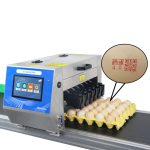 Six Head Egg Inkjet PrinterS10-6 |
High-volume grading lines on standard trays | ≈ 36,000 eggs/hour20 trays/min600 dpi HD | 12.7 mm max | USB / HDMI |
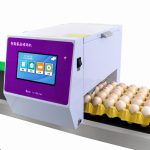 Six Nozzle Egg Coding MachineS600D |
Mixed tray layouts that must not be sorted | ≈ 36,000 eggs/hour20 trays/min300-600 dpi | 2-12.7 mm | USB, RS232 |
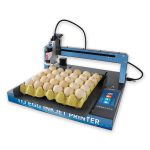 XY110 Egg Inkjet PrinterXY110 |
Smaller farms, duck eggs and mixed sizes | ≈ 9,800 eggs/hour30 eggs in ~11 s300-600 dpi | 2-12.7 mm | USB, DB9 |
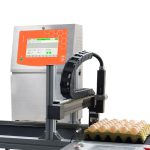 Small Character Egg PrinterS200PLUS |
20 mm characters, database codes | ≈ 7,200 eggs/hour15 s per traydpi on request | 2-20 mm | USB, RS232, Ethernet |
Hourly figures are calculated from the speed the factory publishes, on a standard 5 × 6 tray (30 eggs). Real throughput follows your line speed, loading and stoppages.
Tell us your daily output, tray format and grader pitch and we will come back with a layout, not a brochure.
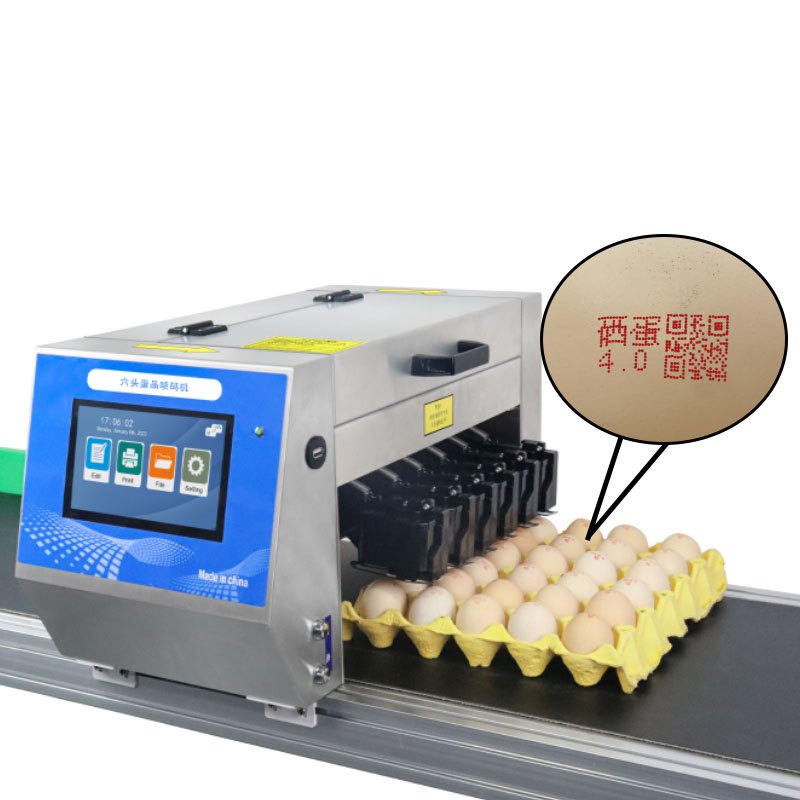
S10-6
Six print heads, one full 5×6 tray per pass
SHICAI builds food-grade egg coding machines for poultry farms and packers in the US, UK, EU, Australia and worldwide. Tell us your daily volume and egg types, and our engineers will recommend the right model and send a free sample print.
Tell us about your line — we reply within 24h.