At 30,000 eggs a day, the egg date stamp is rarely the slow part; the print heads can keep up. What eats the shift is everything around them: loading trays, the gap between one tray and the next, and the few minutes someone spends changing the date at handover. Here is where the handoffs happen, and what changes once you stop printing egg by egg.
Start with the arithmetic. A standard 5×6 tray holds 30 eggs, so 30,000 eggs is 1,000 trays. At 20 trays per minute, about 600 eggs per minute, printing them all takes 50 minutes.
Owners blame the egg date stamp first. Fifty minutes out of an eight-hour shift says the fault sits somewhere else.
Walk the line at this volume and three handoffs take the time.
The difference is easier to see as a count than as a speed figure.
| Method | Actions per 5×6 tray | What it costs you | Where it fits |
|---|---|---|---|
| Hand stamp | 30, one egg at a time | One person’s full shift, and pressure that varies by the hour | Roadside sales and small standing orders |
| Single head, inline | 30 stops, one egg at a time | The line waits while the head travels | A few thousand eggs a day |
| Six heads over the tray | 1 pass for 30 eggs | Loading and tray changeover become the constraint | Tens of thousands a day |
Pack date. US graded packs carry a three-digit day of the year, and the grading service defines what that pack date means. The USDA grading standards for shell eggs are the reference most packhouses work from.
Best before. Under the British Lion code the date goes on the shell itself, in a form a shopper reads without a decoder. In much of the EU that same date sits on the carton instead, while the shell carries the producer code below.
Producer code. In the EU the stamp identifies the producer and the production method. This single line is why hand stamps fall short at scale: the code changes with the flock, and rubber type does not.
Add a lot code and you are printing two or three lines per egg, with no room for a reprint on a few centimetres of curved shell.
An egg date stamp that rubs off in the cold store is worse than none at all, because it looks like someone tried to hide something.
Eggshell is not paper. Fresh shells carry a thin cuticle, and brown and white shells hold ink differently. Food-grade water-based red ink is the usual choice because it sits on the surface rather than soaking in, and red stays legible on both shell colours.
Print distance matters as much as the ink. Non-contact printing at 2–5 mm keeps the head clear of the shell while holding the dot pattern tight. Move it further out and characters soften at the edges, where a scanner guesses.
Condensation is the quiet failure: eggs move from a cool grading room into a warmer packing area, a film of water forms, and ink that has not set will smear under a thumb.
On the lines we commissioned, the fix was rarely a different ink. It was printing earlier in the tray’s travel, so the code had the conveyor’s length to dry.
If you are near this volume, three numbers tell me almost everything: eggs per day, tray format, and the pitch your grader runs at.
Same factory, four jobs. At this volume read the top two rows first: equal speed, different tray handling.
| Machine | Best for | Speed and resolution | Height | Interface |
|---|---|---|---|---|
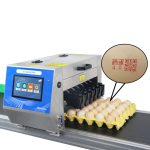 Six Head Egg Inkjet PrinterS10-6 |
High-volume grading lines on standard trays | ≈ 36,000 eggs/hour20 trays/min600 dpi HD | 12.7 mm max | USB / HDMI |
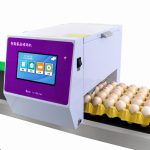 Six Nozzle Egg Coding MachineS600D |
Mixed tray layouts that must not be sorted | ≈ 36,000 eggs/hour20 trays/min300-600 dpi | 2-12.7 mm | USB, RS232 |
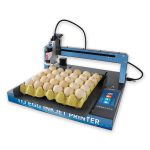 XY110 Egg Inkjet PrinterXY110 |
Smaller farms, duck eggs and mixed sizes | ≈ 9,800 eggs/hour30 eggs in ~11 s300-600 dpi | 2-12.7 mm | USB, DB9 |
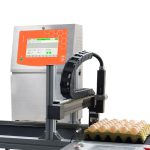 Small Character Egg PrinterS200PLUS |
20 mm characters, database codes | ≈ 7,200 eggs/hour15 s per traydpi on request | 2-20 mm | USB, RS232, Ethernet |
Hourly figures are calculated from the speed the factory publishes, on a standard 5 × 6 tray (30 eggs). Real throughput follows your line speed, loading and stoppages.
Send those and I will come back with the head count that fits and what to check on the first tray after a changeover. The six-head egg inkjet printer page lists current specifications, the solution archive covers how other packhouses handled the same jump, and you can send your numbers through the quote form.
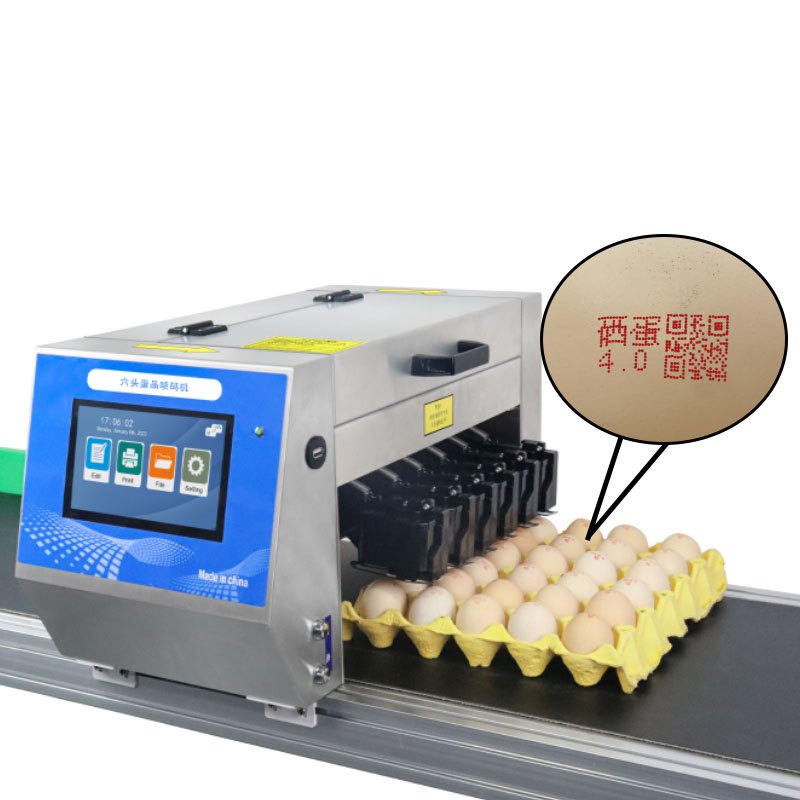
S10-6
Six print heads, one full 5×6 tray per pass
SHICAI builds food-grade egg coding machines for poultry farms and packers in the US, UK, EU, Australia and worldwide. Tell us your daily volume and egg types, and our engineers will recommend the right model and send a free sample print.
Tell us about your line — we reply within 24h.