Buyers who type eggs printer into a search bar usually want one of two things: a machine for a packing line, or a way to mark a few dozen eggs for a farm shop. Those are different purchases, and mixing them up is the most expensive mistake in this category.
The same term covers a 12 kg portable unit that sits on a bench and a six-head array bolted over a conveyor. Both put ink on a shell. Neither is a substitute for the other, and a quote that does not ask which one you need is a quote you cannot compare.
The clarifying question is always the same: where do the eggs come from and where do they go? Off a grader into a tray is one answer. Out of a basket into a carton is another.
Volume separates them fastest. A bench unit suits a few thousand eggs a day and moves wherever it is needed. An inline array assumes fixed plumbing: a conveyor, a power drop and a place to bolt a frame.
None of the five is exotic. They surface in almost every project, and the packers who plan for them are running on the second day rather than the second week. Ask for the response time in writing, because a line in an email is worth more than a clause in a brochure.
Day one is mounting and dry runs. Day two is live trays at full speed, which is when the trigger timing gets adjusted for the third time. By day three the operator should be running the machine alone, and by the end of the week the settings card should be filled in.
If week one ends with an engineer still on site, either the conveyor is unusual or the scope was never written down. Both are avoidable with photographs of the frame and a tray sample sent before the order.
For a hall that already runs a grader, the Six Nozzle Egg Coding Machine is designed to shorten that week: it mounts over existing grading and packing conveyors, adjusts head spacing and trigger timing to tray pitch, and codes 20 trays per minute without slowing the line.
Four items carry the price: heads, mounting steel, controller and ink over the first year. Buyers compare the first three and forget the fourth, which is the one that repeats every month.
Ask for the first-year consumable estimate at your real character size. A short date code and a full traceability block use very different amounts of ink, and the difference is large enough to change which machine is cheaper over three years.
If your buyer grades to a published standard, the reference they will cite is the USDA egg grading standard, which is also where the terminology on the shell mark comes from.
Tell us which kind of eggs printer you are buying, and the rest of the quote narrows quickly. Trays per minute and egg types settle the head count. The code content settles the controller.
The question archive covers mounting, ink and cleaning in more detail. To price a line, send the conveyor photo, or start with the four machines we build.
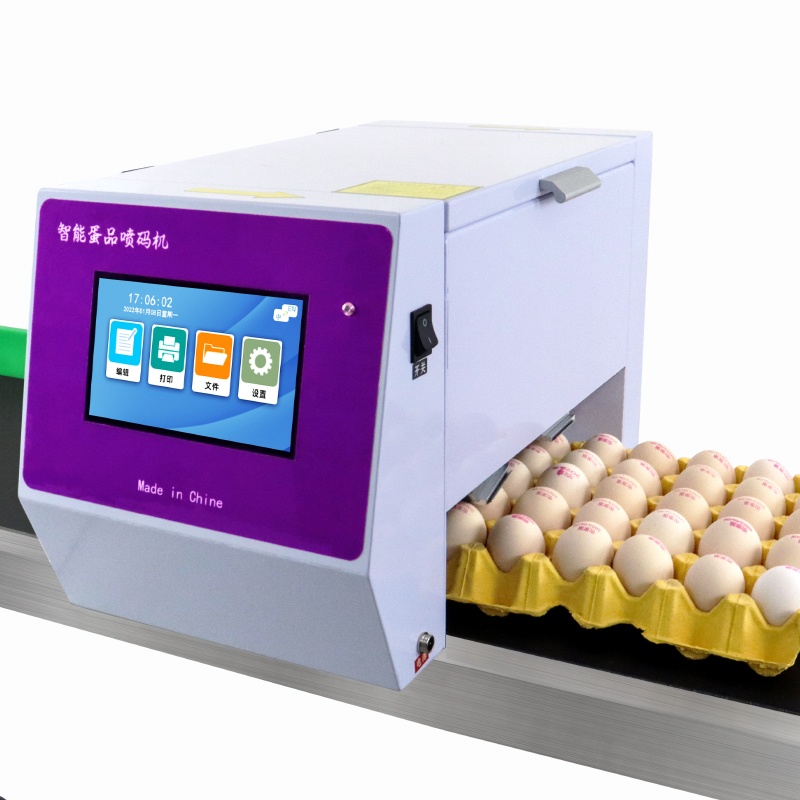
S600D
Six nozzles, one full tray, no sorting needed
SHICAI builds food-grade egg coding machines for poultry farms and packers in the US, UK, EU, Australia and worldwide. Tell us your daily volume and egg types, and our engineers will recommend the right model and send a free sample print.
Tell us about your line — we reply within 24h.