Cost per egg is the only comparison that survives contact with a real packhouse. An egg stamping machine and an inkjet unit can look close on a quotation page, but purchase price flatters whichever one needs more labour, and labour repeats every day the grader runs.
The category split years ago. A manual stamp is a hand tool with a pad, still sold and still useful. An automatic egg stamping machine feeds eggs past a contact head, marking one at a time or in a row. Both are contact methods, and contact is the part that carries consequences.
Contact means the head touches the shell, which means the shell has to be positioned precisely, and the head has to be cleaned on a schedule. It also means the mark depends on pressure, and pressure from a tired operator or a worn pad varies through a shift.
| Cost line | Contact stamping | Non-contact inkjet |
|---|---|---|
| Capital | Low for a hand tool, moderate for automatic | Higher, and depends on head count |
| Labour | One person per line, all shift | Operator checks rather than marks |
| Consumables | Pads, ink, replacement heads | Cartridges, occasional head or cable |
| Changeover | New pad or new stamp per code change | Edit on screen |
| Rejects | Uneven pressure and pad wear | Missed trays when the trigger drifts |
| Cleaning | Pad hygiene is an audit item | No shell contact, wipe-down only |
Add the six lines for your own volumes and the answer usually lands within a season. The capital difference is recovered in labour long before the machine is out of warranty, provided the line runs most days.
Two of those lines are easy to underestimate. Rejects rarely appear in a supplier’s payback model, yet a code that has to be re-run by hand costs the same as a code that was never printed. Cleaning is the other: a contact pad needs a routine that somebody owns, and a routine without an owner quietly stops happening in month three.
A few hundred eggs a day: the hand tool wins, and nothing else is close. A few thousand a day on one shift: contact automation and a compact inkjet unit are within reach of each other, and hygiene usually decides. Above that, the inline array wins on labour alone.
The shape of the line matters as much as the count. If eggs already travel on a conveyor, a XY110 Egg Inkjet Printer prints at 2 to 12.7 mm height with 300 to 600 dpi, sits beside the belt and needs no contact with the shell. It weighs 12 kg, so the same unit serves a second house when the first is done for the day.
If eggs arrive in baskets and leave by hand, contact stamping stays competitive until the marking queue starts delaying the packer.
The crossover moves with your product mix, not just your volume. A packer running three egg sizes spends more time changing pads than a packer running one, and that time is invisible on a quotation but obvious on a Friday afternoon.
Four things move an inkjet quote: head count, print height, controller capability and the mounting. Consumables move the running cost, and the running cost is where two similar quotes diverge most.
Ask each supplier for cost per thousand eggs at your character size, including labour at your own rate. A number built on the supplier’s assumed labour rate is not your number.
If the mark has to satisfy a food-safety audit, the ink specification is the first document to request. ISO 22000 is the framework most buyers cite, and it asks for evidence of what touched the food, which a contact pad makes harder to answer than a sealed cartridge.
Send your daily egg count, your shift pattern and whether eggs move on a conveyor. Those three answers decide whether the comparison should be against a hand tool, an automatic stamper or an inkjet unit.
For a side-by-side on marking methods, read the solutions library. To price a line against your own labour rate, send the numbers, or start with the machine range.
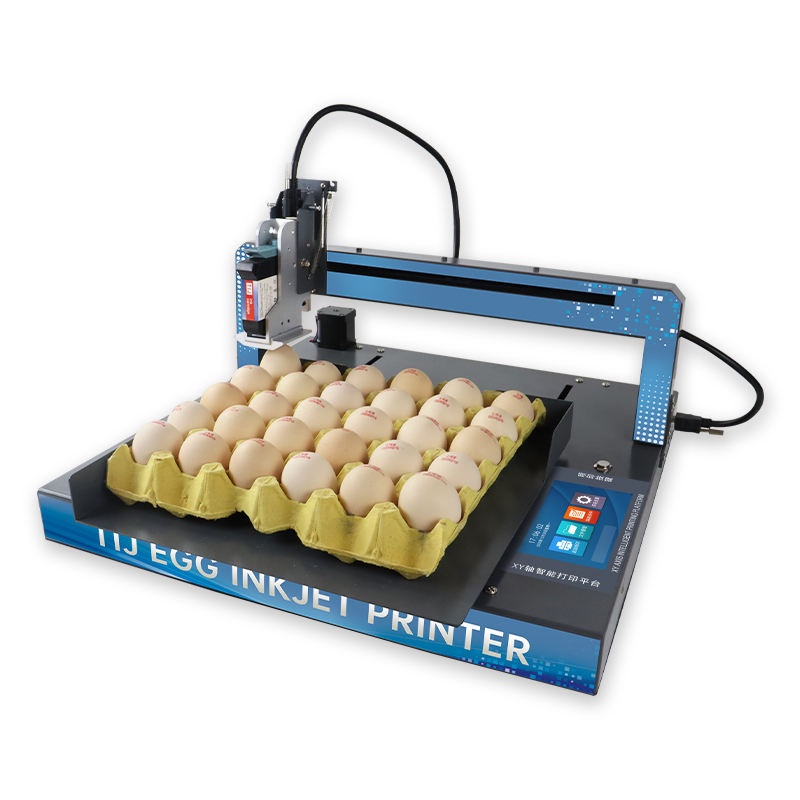
XY110
Tray-type XY gantry, one full tray in about 11 seconds
SHICAI builds food-grade egg coding machines for poultry farms and packers in the US, UK, EU, Australia and worldwide. Tell us your daily volume and egg types, and our engineers will recommend the right model and send a free sample print.
Tell us about your line — we reply within 24h.