The case for egg printing has not changed: a mark on the shell is cheaper than a label on the box and harder to lose in the cold chain. What changed in 2026 is who is asking for it. Retail buyers now request lot-level traceability in contracts that used to mention only grade and weight.
Three years ago most of our enquiries came from packers replacing a hand stamper. Today the same question arrives from farms that already own a grader and want the marking step removed from the end of the line, where two people were doing it by hand.
The pressure is not only labour. Buyers audit the mark itself: is it legible after chilling, does it survive a damp tray, can the code be read back to a flock and a date. A smudged producer code now triggers a claim, not a shrug.
Thermal inkjet heads have held their place because they fire without touching the shell. Contact methods still dominate very small volumes, where a hand stamp costs less than any machine and the daily count is a few hundred eggs.
The middle of the market moved. A six-head array that once only made sense on the largest lines now fits packers running a single grader, because the per-egg cost falls as soon as the marking step stops consuming operator time.
Installation also simplified. The Six Nozzle Egg Coding Machine mounts over existing grading and packing conveyors, with head spacing and trigger timing adjusted to tray pitch. A sealed ink path is what makes that practical in a humid hall, and the unit runs on 110V or 220V for export.
Most failures we are called to are not print failures. They are placement failures. The code lands on the shoulder of the egg, or on the tray lip, because the trigger was never timed to the pitch of the conveyor.
The second common fault is ink for the wrong room. A water-based ink that sets cleanly in a warm packing hall behaves differently in a chilled store, and the difference shows up as a smear on the pallet, not on the test sheet.
Both are commissioning issues, not equipment issues, which is why a supplier who asks about your room temperature and tray pitch before quoting is worth more than one who quotes fastest.
For a line of this size, price splits into three parts: the head array, the mounting and trigger work, and consumables over the first year. The last part is the one buyers forget, and it is the one that decides whether the machine is cheap.
Ask for a budget band that includes the first year of cartridges. A quote that covers only the hardware hides the running cost, and the running cost is where two suppliers can differ most while looking identical on paper.
If your buyer requires documented food-safety practice, the wider factory standard behind most audits is ISO 22000, which covers handling and traceability rather than the ink alone.
Two numbers decide the machine: trays per minute at your peak, and how many hours a day the grader runs. Add your egg types and the code content, and the head count and ink follow from those facts rather than from a preference.
The solutions library covers stamps, labels and inline arrays with the same numbers so the comparison is fair. For a fit check on your own conveyor, ask an engineer, or read the most common questions first.
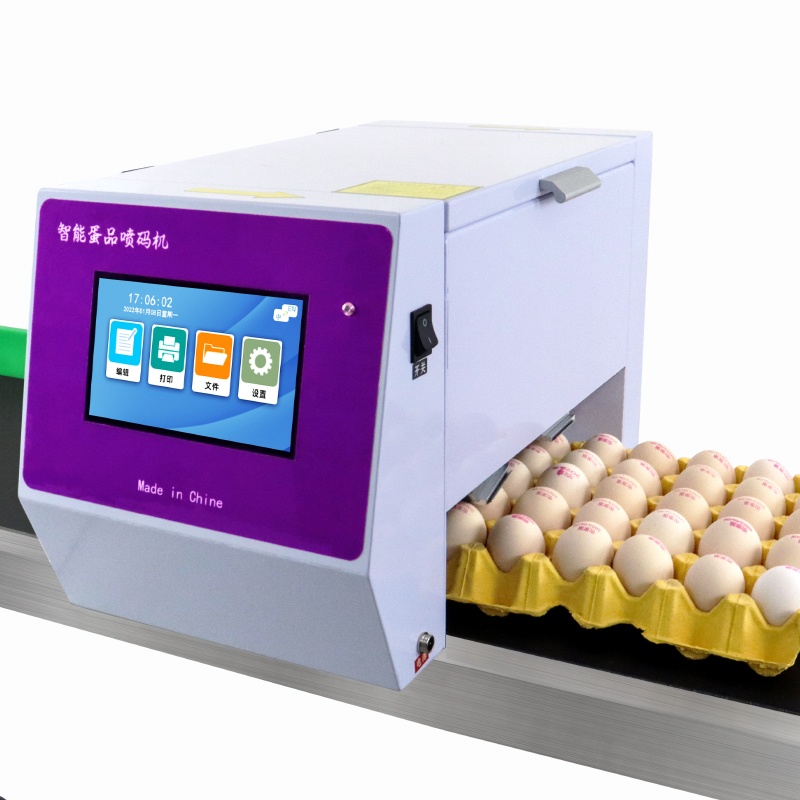
S600D
Six nozzles, one full tray, no sorting needed
SHICAI builds food-grade egg coding machines for poultry farms and packers in the US, UK, EU, Australia and worldwide. Tell us your daily volume and egg types, and our engineers will recommend the right model and send a free sample print.
Tell us about your line — we reply within 24h.