An egg marking machine does two jobs that look like one. It prints what the retailer wants to read, and it prints what the regulator requires to be there. When those two lists differ, the regulated one wins, and the machine has to be set up for the stricter of the two.
On a shell egg sold in the UK or the EU, the mark usually carries a producer code, a country of origin and a digit that identifies the farming method. The producer code is the part that identifies the holding, and it has to stay legible from packing through to the shelf.
Retail buyers then add their own requirements: a best-before date, a packing date, a lot number, sometimes a QR code pointing at a farm page. Those are contract terms rather than law, but a machine that cannot vary data per tray will fail the contract long before it fails an inspection.
The two regimes diverged after Brexit but the shape of the mark stayed familiar. Both expect a legible, permanent mark applied at the packing stage, and both expect the mark to match the eggs in the tray.
| Element | Typical requirement | What the machine must do |
|---|---|---|
| Producer code | Identifies the holding | Fixed text, repeated every tray, always legible |
| Country of origin | Shown on the shell | Fixed text or part of the code string |
| Farming method | Single digit convention | Fixed or switched by product run |
| Date and lot | Buyer or retailer requirement | Variable data, changed without stopping the line |
| Durability | Survives packing and retail handling | Ink that sets on the cuticle, not a surface film |
The exact wording of each rule sits in national guidance, and it changes. The UK Food Standards Agency publishes the current position for England, Wales and Northern Ireland, and the devolved agencies publish their own. Treat any article, including this one, as a prompt to check the official text.
Not on print quality. On traceability of the setup. An auditor asks which code was printed on which day and how the operator knows. If the answer is a verbal recollection, the mark itself becomes questionable even when every character is crisp.
The second failure is a code that drifts between trays because the trigger was set to the average pitch. One tray in fifty lands the producer code on the shoulder of the egg, where it reads poorly on the shelf.
The third is a changeover. Switching from one farm’s code to another mid-shift without a written step is how the wrong mark ends up on the right eggs.
We have also seen audits fail on ink documentation. The mark is on the food, so the question of what carried it is a fair one, and a supplier who cannot produce an ink specification turns a routine check into a fortnight of correspondence.
Compliance adds two costs to a machine: variable data capability and a documented changeover. The first is a controller question, the second is a process question, and both are cheaper to design in than to retrofit.
A Six Head Egg Inkjet Printer handles the first part comfortably: 600 dpi at up to 12.7 mm character height across a full 5×6 tray in one pass, 20 trays per minute, with food-grade water-based red ink and a non-contact 2 to 5 mm print distance.
The process part costs nothing but discipline. A laminated card at the station listing code string, ink batch and changeover steps removes the failure auditors actually find.
Budget for one extra thing that rarely appears in a quote: the hour it takes to set up a new farm code properly. Multiply it by the number of suppliers you pack for in a busy week and it becomes a real number, small enough to ignore and large enough to explain a slow Monday.
Write the required code string first, then choose the machine. Suppliers who are asked to quote before the string exists will size the controller on a guess, and variable data is the expensive part to upgrade later.
The solutions library covers how different marking methods handle variable data. To check a code string against a machine, send it to an engineer, or review the full range first.
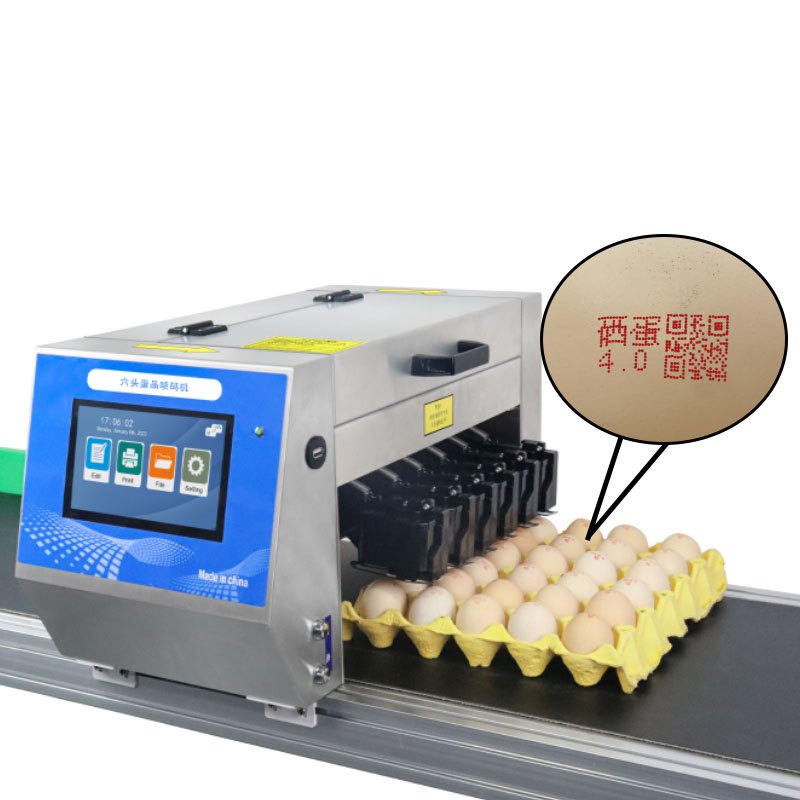
S10-6
Six print heads, one full 5×6 tray per pass
SHICAI builds food-grade egg coding machines for poultry farms and packers in the US, UK, EU, Australia and worldwide. Tell us your daily volume and egg types, and our engineers will recommend the right model and send a free sample print.
Tell us about your line — we reply within 24h.