Egg coding rarely fails because the printer is bad. It fails because a detail nobody owned at commissioning comes back every morning: a trigger that fires late, a cartridge stored on a warm shelf, a head height set once and never checked. Five of these mistakes account for most of the downtime we get called about.
A packing hall is a hostile place for a print head. Shell dust floats, wash water lands where it should not, and the line runs faster at 6 a.m. than it did during the afternoon demo. A machine that performs perfectly in a showroom can miss one tray in twenty under those conditions.
The good news is that the failure modes repeat. Fix the five below and the line stops generating the same callout every week. We once traced a recurring miss to a tray rail that had been adjusted for a different egg size. The printer was fine. The geometry had moved under it, and the machine took the blame for a change someone made three metres upstream.
Legibility comes from four variables working together: distance, dwell time, ink and substrate. Change one and the others usually need attention too, which is why swapping ink brands mid-season so often ends in a smear.
For carton work and larger characters, the constraints shift. The Small Character Egg Printer runs a 2 to 20 mm print height across a 3 to 30 mm working distance, prints dynamic barcodes and QR codes, and pulls codes from an external database or a serial feed. That matters when the code is generated per box rather than typed by an operator.
Shell work is less forgiving. There is no second surface, no label to fall back on, and the code has to survive condensation on the way to the chiller. Read the mark the way your buyer will read it, at arm’s length under shop lighting rather than under the workshop lamp. A character that looks crisp on the line can close up completely on the shelf.
Downtime is the expensive part, not the printer. A single missed shift at a mid-size packer outweighs the difference between two quotes, and that is the comparison worth making before you choose on price.
Ask what a five-year running cost looks like: cartridges per month, one spare head, one spare cable, and the technician hours for an annual service. Suppliers who answer that question quickly tend to be the ones who have supported a line before.
Where the code carries regulated information, keep the mark inside the rules your market enforces. The Codex Alimentarius guidance on food labelling is the reference most export buyers cite when they audit a shell mark.
Send a photo of your current code and the tray layout. Most of the five mistakes above are visible in one image, and an engineer can name the likely cause before anyone travels. Clean egg coding is not a matter of better equipment, it is a matter of one person owning the settings.
If the line is already running, the question archive covers head height, ink storage and trigger setup in more detail. For a straight answer on your own layout, send the details, or compare units in the solutions library.
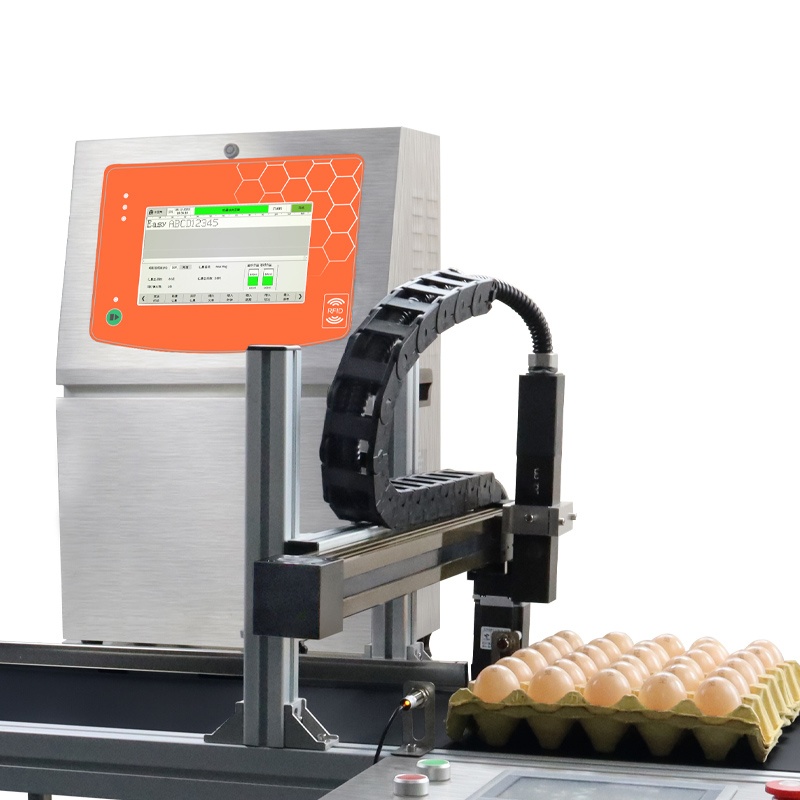
S200PLUS
20 mm characters and database-driven codes on eggs
SHICAI builds food-grade egg coding machines for poultry farms and packers in the US, UK, EU, Australia and worldwide. Tell us your daily volume and egg types, and our engineers will recommend the right model and send a free sample print.
Tell us about your line — we reply within 24h.