Most buyers who feel they paid too much for an egg coding machine did not choose badly. They bought a specification they never used: extra heads, an enclosure rated for a wash-down they do not run, or software for a traceability program that starts next year. Here is how to size one honestly.
The job is narrow. A head fires ink onto a shell moving past it, at a distance the ink can cross without touching the egg. Everything else in the quote, from the frame to the software, exists to keep that one action repeatable across a shift.
That is why a portable unit and a six-head array can both be correct purchases. One is built to move between houses and code a few thousand eggs a day. The other is bolted over a conveyor and codes whole trays at line speed. Buying the second when you need the first is how budgets get lost.
Three packing styles cover nearly every enquiry we get, and each points at a different machine.
For the middle case, the XY110 Egg Inkjet Printer is the honest answer: 12 kg, 56 × 56 × 28 cm, an adjustable 2 to 12.7 mm print height, and a 5.0-inch touch screen that an operator can learn in a morning. It takes 42 ml food-grade cartridges in water-based or oil-based ink, so the same machine covers shell marking and carton work without a second purchase.
Two machines with the same head count can differ by a wide margin, and the gap is rarely the print engine. Mounting steel, trigger sensors, the controller and the ink path account for most of it.
Ask for the quote split into machine, mounting and consumables. A supplier who cannot separate those three lines is quoting a package, and you cannot tell which part you are overpaying for.
Code content also moves the number. A fixed date stamp needs almost no setup. Variable lot, farm and expiry data needs either a keypad entry step or a database link, and that link is engineering time.
Regulation is the one place where spending early pays back. Under EU egg marketing standards, shell marks carry producer codes that must stay legible through packing and retail. A machine that prints a clean character on the first pass is cheaper than one that needs a second operator checking every tray.
Tell us the packing style first, trays per minute second, and the code content third. Those three answers remove most of the optional extras from the quote before it is written.
If you are still weighing a compact unit against a fixed array, the solutions library compares both against stamps and labels. To get a budget band for your line, send your tray details, or start from the machine range.
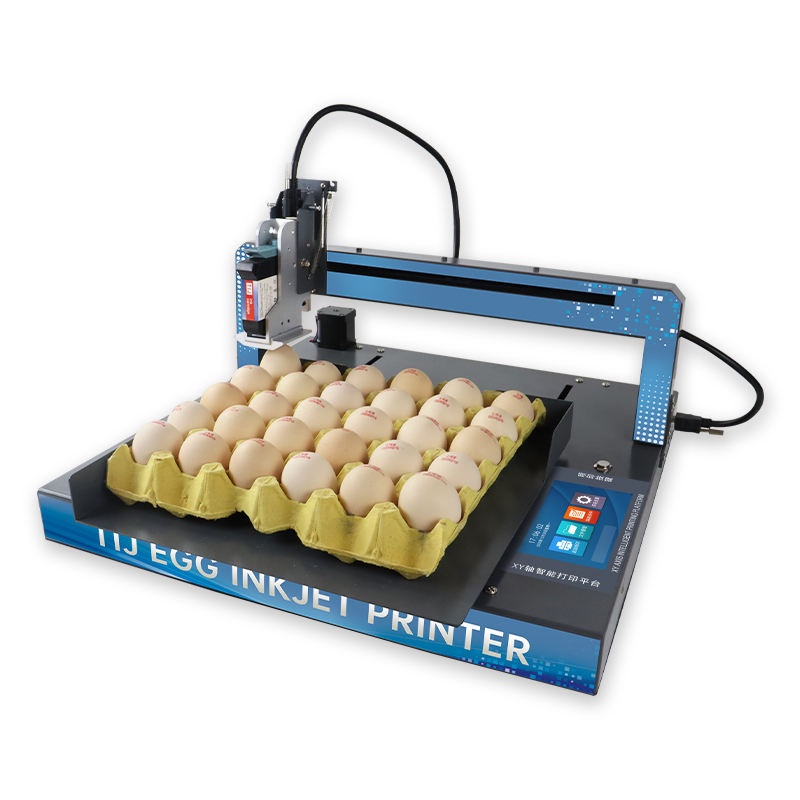
XY110
Tray-type XY gantry, one full tray in about 11 seconds
SHICAI builds food-grade egg coding machines for poultry farms and packers in the US, UK, EU, Australia and worldwide. Tell us your daily volume and egg types, and our engineers will recommend the right model and send a free sample print.
Tell us about your line — we reply within 24h.