Egg coding cost is usually quoted as one number, the price of the machine, and that number answers the wrong question. A cheap unit that needs a second operator, or a cartridge that fails halfway through a shift, costs more per egg than a machine with a bigger sticker. Here is where the money actually goes, and which line to argue about.
Four lines carry almost all of the egg coding cost, and only one appears on the quote.
| Cost line | One-off or ongoing | What gets underestimated |
|---|---|---|
| The machine | One-off | Whatever has to change around it to make trays fit |
| Ink and cleaning | Ongoing | Ink used at start-up and at every head clean |
| Operator time | Ongoing | The minutes lost at every batch and shift change |
| Downtime | Ongoing, but invisible | Double prints, missed rows and the rework behind them |
The quote covers the first line. The other three decide whether the machine was a good buy.
Buying throughput they never run. A line that packs four trays a minute does not need a station built for twenty. Paying for idle capacity is the most common overspend, and it is invisible because the machine looks impressive.
Buying interfaces they never use. Ethernet and database links earn their place when codes come from a system. If the code is a date and a farm name, they are a feature on a brochure.
Buying a line rebuild they did not need. Some trays do not fit an inline station without moving the grader. A tray machine that takes the tray as it comes avoids that work altogether.
Cheap ink. A cartridge that clogs turns a five-minute clean into a stopped line. The saving is real and the cost lands somewhere else.
Skipping the drying gap. Codes that reach packing wet transfer to the egg above, and the transfer looks like a printing fault to the buyer.
Skipping the training. One operator who knows the format is not a system. The shift that follows will invent its own.
Ink is the line that varies most and is quoted least. A 42 ml cartridge is sized for a shift of trays, not a week of them, unless the head is cleaned after every tray.
The only comparison that holds across machines is cost per thousand eggs, including operator time and rework.
Work it out on a month rather than a purchase. Take the machine cost, spread it over the eggs it will code in three years, then add ink, cleaning and the hours spent at the station.
Most farms find the spread is smaller than expected and the operator hours are larger. That is the useful surprise, because operator hours are the part a better layout can reduce.
The same arithmetic explains why three small units can beat one large one on a farm with several sheds. Each shed codes its own output, no tray crosses a yard, and the same operator covers all three between changeovers.
A tray-type XY gantry is the low-volume answer for most farms: the tray becomes the fixture, so nothing is unloaded, restacked or carried past a fixed head.
One pass covers a standard 5×6 tray in about eleven seconds, with print height adjustable from 2 to 12.7 mm and resolution from 300 to 600 dpi. The head follows egg size on its own, which matters on a farm packing more than one grade.
The packaged unit weighs 12 kg, so it moves between sheds without a forklift.
A 5-inch touch screen holds the jobs, and USB, DB9 and Bluetooth cover code transfer. Details are on the XY110 tray egg inkjet printer page.
Ask what happens to the price when the tray changes. Ask who cleans the head and how often it needs doing. Ask what the first hour of a shift looks like when the operator is new.
Then ask for the code layout, not the specification sheet. A machine that fits the layout you actually print is cheaper than one that beats it on paper.
UK producer guidance describes what a shell mark has to carry, which is a useful check on how much space the date really needs. It sits on the egg info producer pages.
Layouts for different volumes are collected under our coding solutions.
Same factory, four jobs. On a tight budget the useful question is which row stops costing operator hours first.
| Machine | Best for | Speed and resolution | Height | Interface |
|---|---|---|---|---|
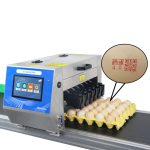 Six Head Egg Inkjet PrinterS10-6 |
High-volume grading lines on standard trays | ≈ 36,000 eggs/hour20 trays/min600 dpi HD | 12.7 mm max | USB / HDMI |
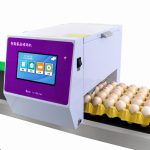 Six Nozzle Egg Coding MachineS600D |
Mixed tray layouts that must not be sorted | ≈ 36,000 eggs/hour20 trays/min300-600 dpi | 2-12.7 mm | USB, RS232 |
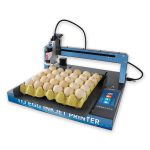 XY110 Egg Inkjet PrinterXY110 |
Smaller farms, duck eggs and mixed sizes | ≈ 9,800 eggs/hour30 eggs in ~11 s300-600 dpi | 2-12.7 mm | USB, DB9 |
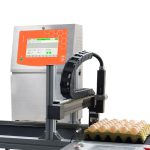 Small Character Egg PrinterS200PLUS |
20 mm characters, database codes | ≈ 7,200 eggs/hour15 s per traydpi on request | 2-20 mm | USB, RS232, Ethernet |
Hourly figures are calculated from the speed the factory publishes, on a standard 5 × 6 tray (30 eggs). Real throughput follows your line speed, loading and stoppages.
Tell us your trays per day and we will price the station against the eggs it codes, not the brochure.
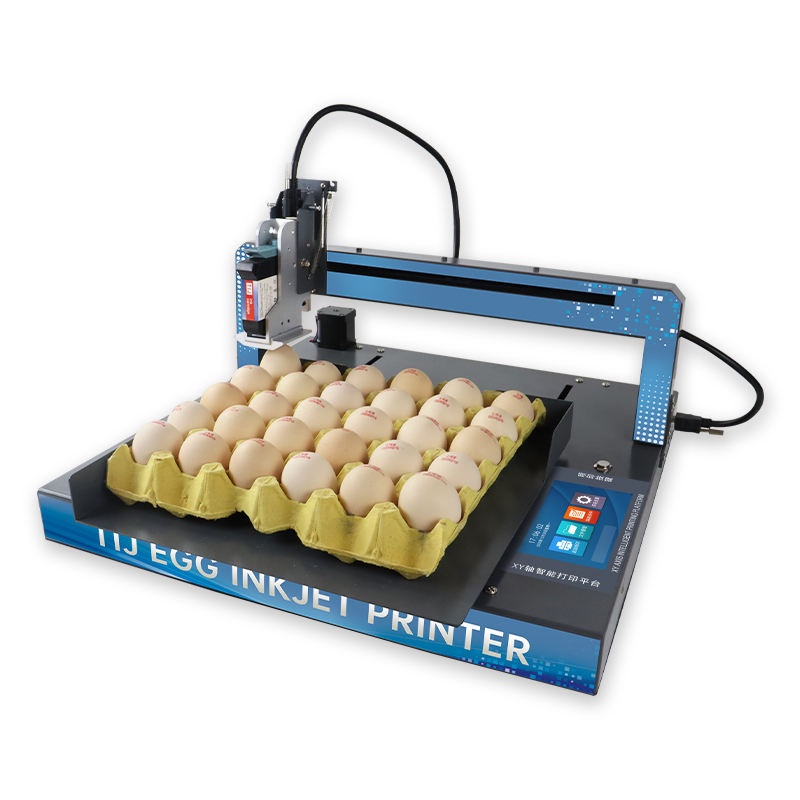
XY110
Tray-type XY gantry, one full tray in about 11 seconds
SHICAI builds food-grade egg coding machines for poultry farms and packers in the US, UK, EU, Australia and worldwide. Tell us your daily volume and egg types, and our engineers will recommend the right model and send a free sample print.
Tell us about your line — we reply within 24h.