Six Head Egg Inkjet Printer

Six print heads, one full 5×6 tray per pass

Model S10-6

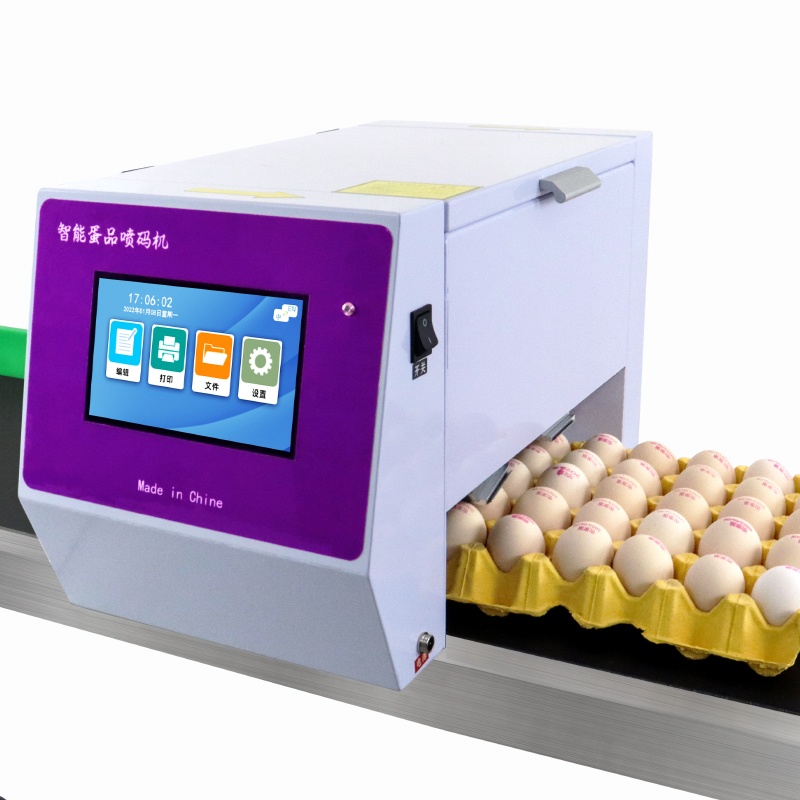
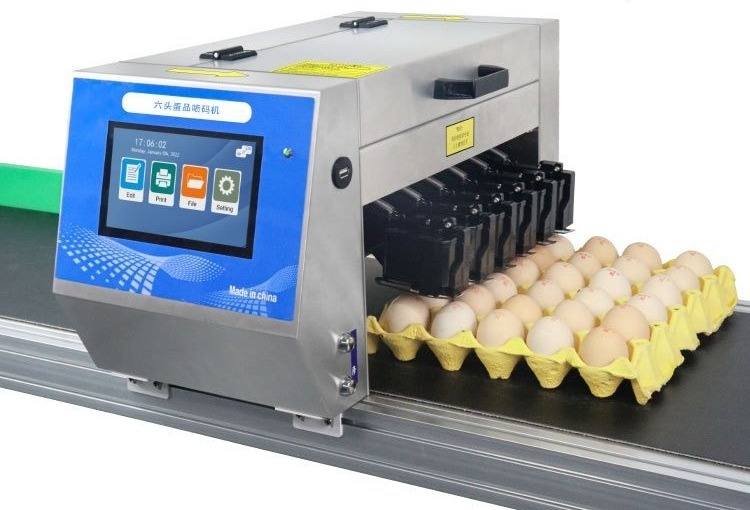
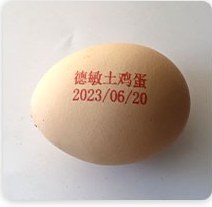
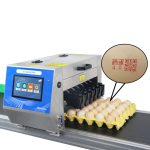
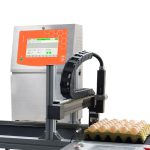
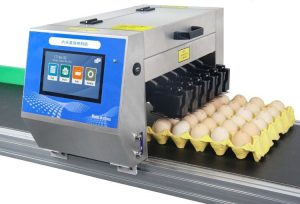
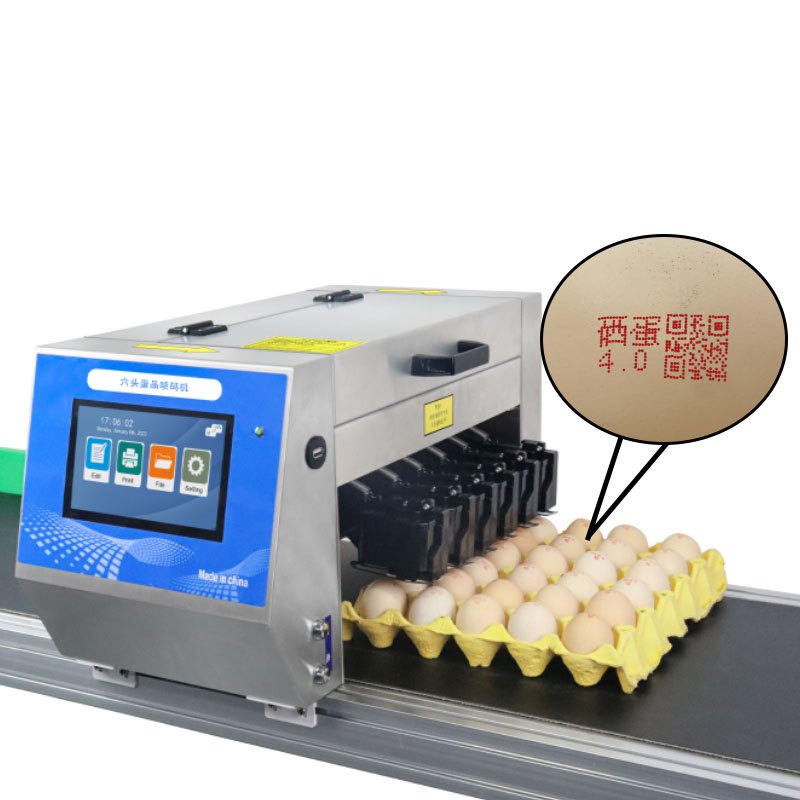
The SHICAI S10-6 six-head egg inkjet printer marks a complete 5×6 tray in a single pass — 30 eggs at a time, 20 trays per minute. Each of the six heads covers its own column, so every egg in the tray receives a production date, batch number, farm code or traceability QR code without being handled individually.

Printing is non-contact. The heads stay 2–5 mm above the shell, so nothing presses on the egg and shell strength never becomes a constraint. Food-grade water-based red ink sits on the surface and holds up through grading, packing and cold storage.

Character height reaches 12.7 mm at 600 dpi, which keeps codes readable for both packers and inspection staff. The unit runs on 110V or 220V, connects over USB or HDMI, loads codes straight from a USB flash drive, and ships with Chinese, English, Arabic, Korean, Spanish, French, Russian, Vietnamese and Bengali interface options.

  • 20 trays/minStandard 5 × 6 tray
  • 30 eggsCoded in one pass
  • 600 dpiPrint resolution
  • 2–5 mmNon-contact gap

Reply within 24 hours · Shanghai, China · Ships worldwide

How it works

Three steps, thirty eggs

No sorting, no breaking the tray apart, no second pass.

  1. 1

    Load the tray

    Set a standard 5 × 6 tray on the transport tape. The fixed baffle squares it against the head bar before printing starts.

  2. 2

    Recall the job

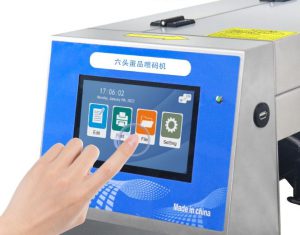
    Pick the saved code on the 7-inch touch screen. Farm name, date, lot and QR code are stored as one preset.

  3. 3

    One pass, 30 eggs

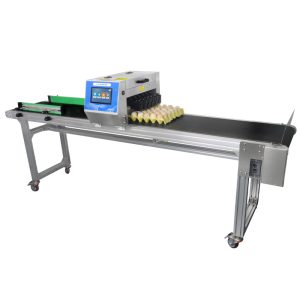
    The head bar crosses once at 20 trays a minute. The tray leaves the belt coded and ready to pack.

On the line: the tray runs under the head bar and leaves the belt coded.
In detail

What you are actually buying

The parts of the machine that decide throughput, code quality and how long a changeover takes.

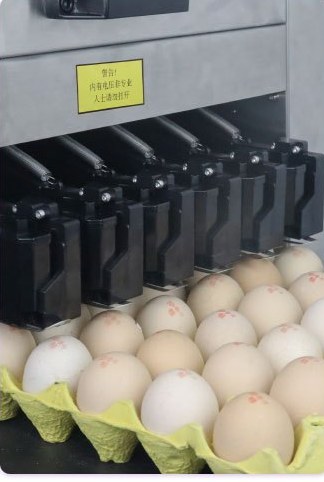
Six independent print heads of the S10-6 positioned over a full tray of eggs
Six heads, one tray: the head bar spans the full 5 × 6 grid.
Core mechanism

Six heads mean you never sort a tray

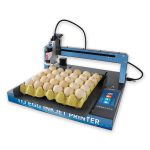
A single-head coder works one egg at a time, so the tray has to be broken down, run through and rebuilt. The S10-6 carries six heads across the width of a standard 5 × 6 tray. All 30 eggs are coded in one pass, and the tray leaves the belt ready to pack.

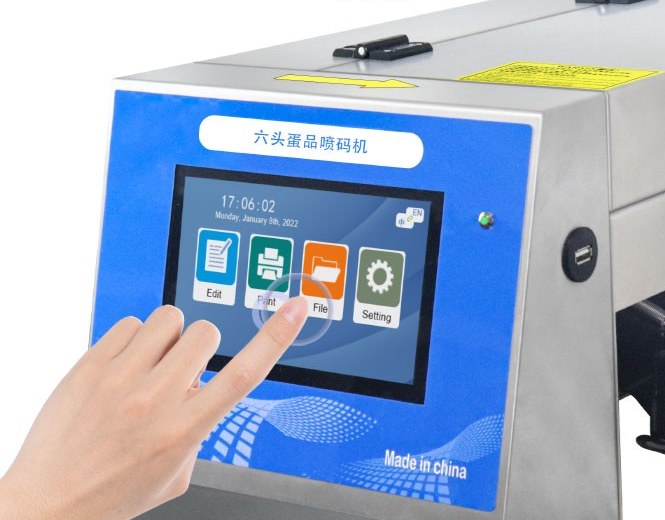
Operator selecting a job on the 7-inch colour touch screen of the S10-6 egg printer
7-inch touch screen: select the saved job, then run.
Controls

Set the job once, then leave it alone

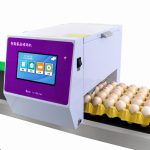
The 7-inch colour touch screen holds the job on the machine, so the operator picks a saved code instead of rebuilding it on a laptop. A shift change is a tap, not a setup.

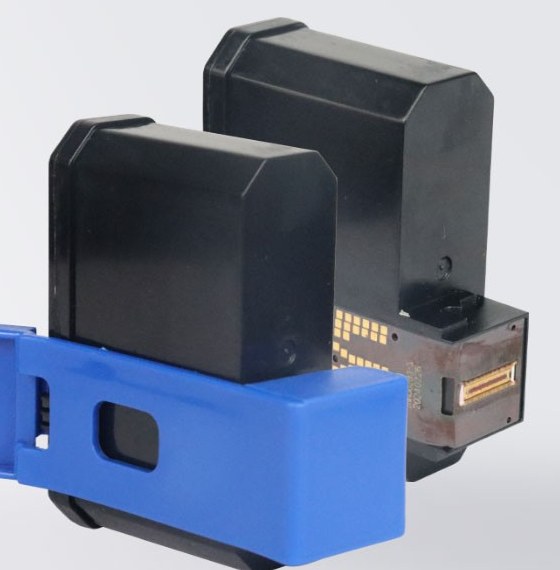
Food-grade water-based ink cartridge used in the S10-6 egg printer
Food-grade water-based ink cartridge.
Food safety

Food-grade ink, and nothing touches the shell

The S10-6 uses food-grade water-based red ink. The head bar runs 2–5 mm above the shell, so the egg is marked without contact and without a pad to clean. Because nothing presses on the shell, surface texture and shell colour do not change the result.

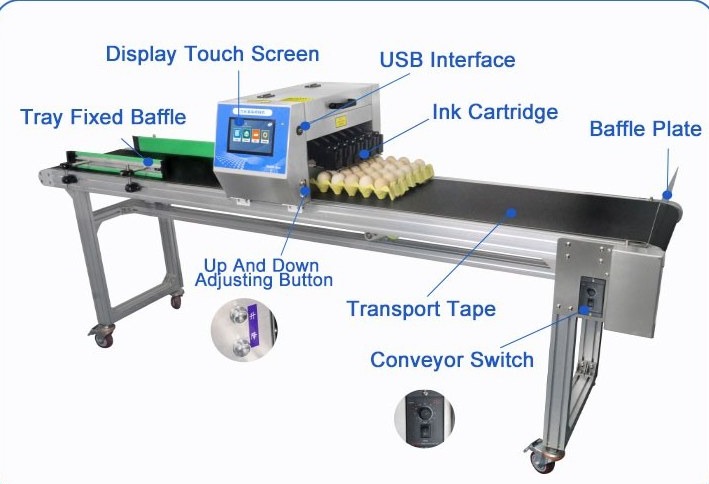
Labelled diagram of the S10-6 egg printer showing touch screen, ink cartridge, transport tape and adjustments
Labelled layout of the S10-6.
Built to be serviced

Everything an operator needs sits on the outside

The tray baffle squares the tray before printing, the transport tape carries it at line speed, and the cartridges lift out by hand. Height adjustment and the conveyor switch sit at the front of the frame, so a changeover does not need a technician.

Compatibility

Trays it already handles

If your line uses one of these, the tray needs no adapter.

Paper cartons Standard 30-egg cartons straight off the grader.
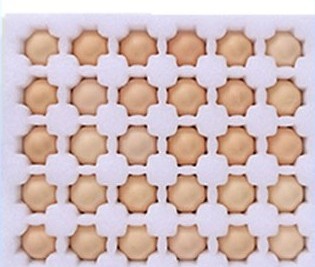
Foam trays
Foam trays Moulded foam trays, including the deeper export pattern.
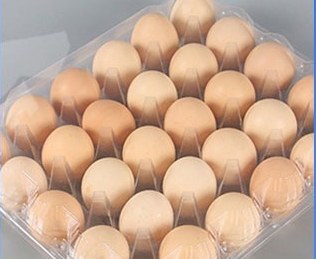
Plastic cartons
Plastic cartons Clear plastic cartons for retail packs.
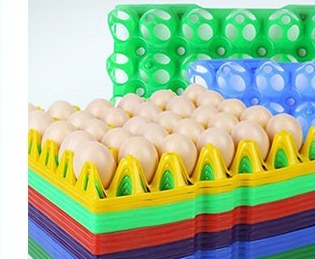
Plastic trays
Plastic trays Stackable trays used on farm collection rounds.
Printed results

What the code looks like on the shell

Photographed on real eggs, not rendered artwork.

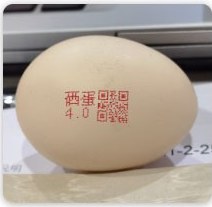
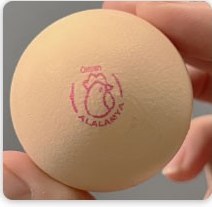
QR and lot code printed on an egg
QR and lot code
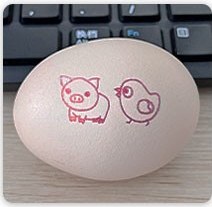
Pattern printed on an egg
Pattern
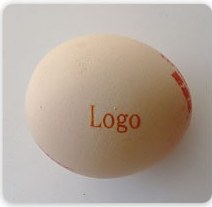
Logo printed on an egg
Logo
Image and text printed on an egg
Image and text
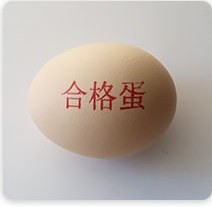
Text printed on an egg
Text
Date and batch printed on an egg
Date and batch
Specifications

Full technical data

ModelS10-6
Print range5 × 6 trays (30 eggs)
Print speed20 trays per minute (standard 5 × 6 tray)
Print accuracy600 dpi HD
Character heightMaximum 12.7 mm
Print distance2–5 mm optimal
Screen7-inch touch screen
Body materialStainless steel
Operating systemMachine OS
MaintenanceAutomatic clean, maintenance free
Nozzle controlEach head prints its own content; any head can be combined with related content
Ink typeFood-grade water-based red ink
External interfaceUSB / HDMI
Rated voltage110V / 220V, 50/60 Hz
Supported languagesChinese, English, Arabic, Korean, Spanish, French, Russian, Vietnamese, Bengali, etc
Printing materialEgg
Warranty12 months
Which machine

Compare the range

Same factory, four different jobs. Pick the row that matches your line.

Machine Best for Coverage Speed Resolution Height Interface
Six Head Egg Inkjet Printer Six Head Egg Inkjet Printer S10-6 High-volume grading lines on standard trays 5 × 6 trays (30 eggs) ≈ 36,000 eggs/hour 20 trays/min 600 dpi HD Maximum 12.7 mm USB / HDMI
Six Nozzle Egg Coding Machine Six Nozzle Egg Coding Machine S600D Mixed tray layouts that must not be sorted 5 × 6 trays (30 eggs) ≈ 36,000 eggs/hour 20 trays/min 300–600 dpi, adjustable 2–12.7 mm × 6 nozzles USB, RS232
XY110 Egg Inkjet Printer XY110 Egg Inkjet Printer XY110 Smaller farms, duck eggs and mixed sizes 5 × 6 trays (30 eggs) ≈ 9,800 eggs/hour 30 eggs in ~11 s 300–600 dpi, adjustable 2–12.7 mm, adjustable USB, DB9
Small Character Egg Printer Small Character Egg Printer S200PLUS 20 mm characters, database codes 5 × 6 trays (30 eggs) ≈ 7,200 eggs/hour 15 s per tray — 2–20 mm USB, RS232, Ethernet

Hourly figures are calculated from the speed the factory publishes, on a standard 5 × 6 tray (30 eggs). Real throughput follows your line speed, loading and stoppages. A dash means the factory has not published that figure — ask us and we will confirm it against your line.

Questions

Before you ask

What Is the Capacity of a Six-Head Egg Printer?

A six-head egg printer codes a full 30-egg tray in one pass and is the workhorse of packing lines. On a standard 30-egg tray it runs 20 trays per minute — 600 eggs per minute, or about 36,000 eggs per hour. Each food-grade cartridge prints tens…

Read the full answer
Single-Head vs Multi-Head Egg Printer

A single-head printer marks eggshells one at a time or in a row; affordable and fine for low volume. A multi-head (commonly 6-head) printer codes a full tray of 30 eggs in one pass, multiplying throughput. Six independent heads can even print different content per row…

Read the full answer
What Is the Tray Speed of an Egg Printer?

Automatic egg coders typically run at about 20 trays per minute on a 30-egg tray — 600 eggs per minute, roughly 36,000 eggs per hour. Note that 20 trays/min and 1,200 trays/hour describe the same machine, so quoted figures can look different without being different. Tray…

Read the full answer
Why Is Non-Contact Printing Important for Eggs?

Eggshells are thin and brittle, and sizes vary. Non-contact printing sprays ink from a few millimeters above the shell, so the head never touches the egg. This eliminates the cracking and bruising that contact stampers can cause. Non-contact coding also prints cleanly on the curved, porous…

Read the full answer
Is Egg Printer Ink Food-Grade and Safe?

Yes, provided you use food-grade ink formulated for eggshells. Egg shells have micro-pores, so ordinary industrial ink could migrate inward and contaminate the egg. Food-grade ink is designed to stay on the surface and be non-toxic. Look for inks that meet FDA (USA) and EU/EFSA food-contact…

Read the full answer
How Does an Egg Printer Keep Up with a Grader?

To keep up with a grader, the coder must match the grader's eggs/min and share speed and trigger signals so printing fires exactly when eggshells arrive. Mounting the coder on the grader's conveyor (or feeding roller) makes coding inline. Multi-head designs code whole trays in the…

Read the full answer

Tell us your line speed

Send the tray type, eggs per hour and current marking step. We reply with the head count and a price within 24 hours.

Get a quote WhatsApp Email
Field notes

Guides written for this machine

Setup walks, line-speed maths and compliance notes from our Solutions desk that name the Six Head Egg Inkjet Printer.

  1. Editor's pick Nov 5, 2026 · 4 min read 30,000 Eggs a Day: The Egg Date Stamp Problem At 30,000 eggs a day the egg date stamp takes only 50 minutes of an eight-hour shift. See where the other seven hours go, and what… Read the guide
  2. Editor's pick Nov 5, 2026 · 5 min read Egg Inkjet Coding for Large Farms: What Must Match Five things that must line up before egg inkjet coding works on a large farm, from tray format and line pitch to code layout, ink standoff… Read the guide
  3. Editor's pick Nov 5, 2026 · 4 min read Your Egg Date Code Is Already a Traceability Tool Why an egg date code traces a pallet back to a flock, which date formats answer which question, and where the string breaks down at the… Read the guide
  4. Editor's pick Nov 4, 2026 · 4 min read Best Egg Printer for Packing Lines: 6 Checks Choosing an egg printer for a packing line? Six checks on tray coverage, ink and service, plus a side-by-side table of the four SHICAI models we… Read the guide
  5. Editor's pick Nov 4, 2026 · 4 min read Egg Coder Setup: Crisp Codes Without Smudging Four egg coder settings that stop smudging: print gap, resolution at line speed, trigger delay and ink for a cold packhouse, plus a routine to repeat. Read the guide
  6. Nov 4, 2026 · 4 min read Egg Marking Machine Rules: UK and EU Compliance What an egg marking machine must print for UK and EU shell egg rules, plus the audit failures that matter more than print quality, and how… Read the guide

See every guide and field note →