Your egg date code is already doing traceability work, whether or not anyone designed it that way. A date on a shell says when the eggs were packed, which flock they came from and which pallet they left on. The only question is whether the format lets anyone read that back six weeks later, when a pallet comes into question.
Read a date on a shell the way a buyer reads it and it says one thing. Read it the way an inspector reads it and it says three.
An example makes it concrete. A string reading 14/11 B2 says the eggs were packed on the fourteenth of November, on shift B, line two. That is enough to open the right page of the packing log without touching a computer.
Format is usually chosen for the printer’s convenience rather than the reader’s. That is the wrong order.
| Format | What it answers | What it cannot answer |
|---|---|---|
| Day and month only | When the eggs were packed | Which run, if two lines packed the same day |
| Julian day of year | How far into the year the pack fell | Which year, once 001 comes round again |
| Date plus a short suffix | Date, shift and line in one string | Nothing, provided the packing log is kept |
The third row is the one that works, and it costs two extra characters.
A date alone cannot separate two runs on the same day. A short suffix can.
One letter for the shift and one digit for the line is usually enough. The suffix does not have to mean anything on its own; it only has to stay unique against the date.
That is the whole trick. The egg date code stays short, and the packing log does the work of carrying the long version.
Farms that print a full batch identifier instead of a short egg date code usually regret it. Long strings force smaller characters, and small characters are the ones a phone camera cannot resolve at the end of a line.
Recall work runs in one direction. A complaint arrives, then a pallet, then a batch, then a flock.
A date plus suffix answers the first two steps in seconds. Without the suffix the same query becomes a search through a day’s output, which at this volume is thousands of trays.
Six heads printing one tray in a pass at 600 dpi keeps that string tight. The machine detail sits on the six head egg inkjet printer page.
Day and month swap. A code printed for a domestic buyer is read by an export buyer who assumes the other order. Two countries, one string, two different dates.
Single digits. One character instead of two shifts every field to the left, and the rest of the line no longer lines up with the tray beside it.
The year boundary. Julian day 001 in January and 001 in the previous December look identical unless the year is printed or the log is checked.
Manual edits. A date changed by hand at shift end carries the risk of a skipped day. Presets on a seven-inch touch screen cut that risk to one selection per shift.
Position drift. A guide rail nudged by a few millimetres moves the date onto the curve of the shell, where it distorts. The string is correct and still unreadable.
Consistency beats cleverness. A plain format that every operator sets the same way is worth more than a compact one that half the shift reads differently.
That means writing the format down, printing it on the wall above the station, and putting it in the job preset so it cannot drift. It also means telling buyers what the string means before they ask.
New operators are the real test. If someone can set the right date on their first shift without asking, the format is simple enough. If not, it will be wrong eventually.
EU food information rules cover how a date is written and read, which is where most of these format errors sit. They are set out in Regulation 1169/2011.
Formats that work across markets are collected under our coding solutions.
Same factory, four jobs. A date plus a suffix stays small, so the top rows are the volume answer and the last two the low-volume one.
| Machine | Best for | Speed and resolution | Height | Interface |
|---|---|---|---|---|
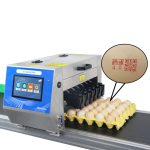 Six Head Egg Inkjet PrinterS10-6 |
High-volume grading lines on standard trays | ≈ 36,000 eggs/hour20 trays/min600 dpi HD | 12.7 mm max | USB / HDMI |
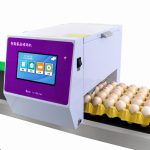 Six Nozzle Egg Coding MachineS600D |
Mixed tray layouts that must not be sorted | ≈ 36,000 eggs/hour20 trays/min300-600 dpi | 2-12.7 mm | USB, RS232 |
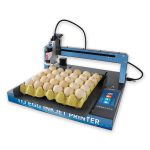 XY110 Egg Inkjet PrinterXY110 |
Smaller farms, duck eggs and mixed sizes | ≈ 9,800 eggs/hour30 eggs in ~11 s300-600 dpi | 2-12.7 mm | USB, DB9 |
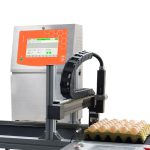 Small Character Egg PrinterS200PLUS |
20 mm characters, database codes | ≈ 7,200 eggs/hour15 s per traydpi on request | 2-20 mm | USB, RS232, Ethernet |
Hourly figures are calculated from the speed the factory publishes, on a standard 5 × 6 tray (30 eggs). Real throughput follows your line speed, loading and stoppages.
Tell us the format you print today and we will tell you what it can and cannot trace.
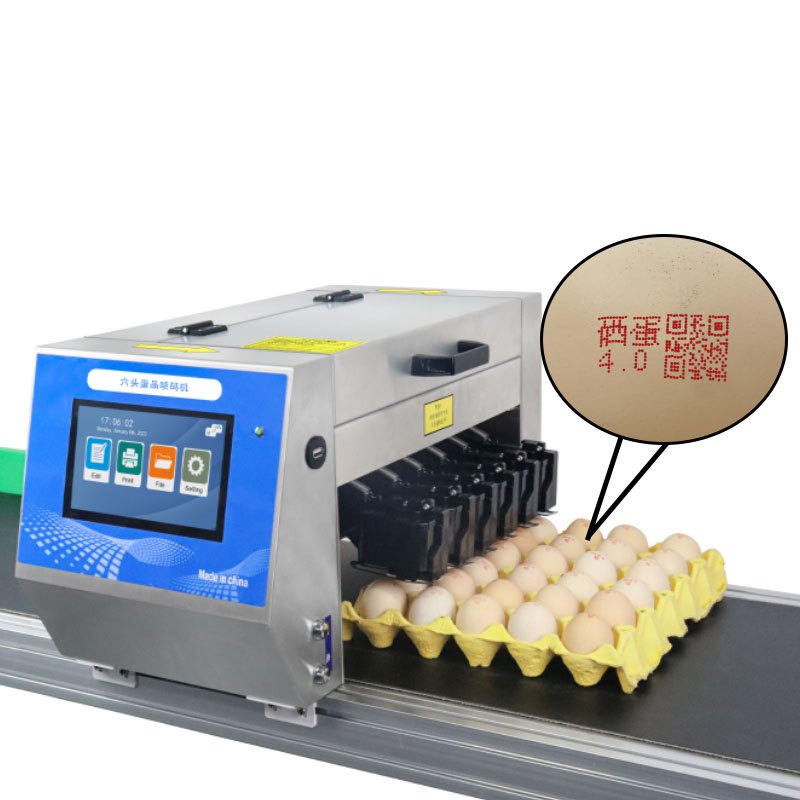
S10-6
Six print heads, one full 5×6 tray per pass
SHICAI builds food-grade egg coding machines for poultry farms and packers in the US, UK, EU, Australia and worldwide. Tell us your daily volume and egg types, and our engineers will recommend the right model and send a free sample print.
Tell us about your line — we reply within 24h.