Egg coding for small poultry farms rarely fails because the machine is wrong. It fails because the farm starts with a specification and no procedure; a few hundred eggs a day need a tray, a saved job and one person who owns the date. Here is the shortest path from a tray of unstamped eggs to a mark you can defend.
A small farm does not need the fields an exporter needs. Two are usually enough to start: the date the eggs were packed, and a name that identifies the farm.
A lot code is the third, and it earns its place as soon as two flocks are laying at once. Before that it is a field nobody reads.
The smallest setup is a tray machine, a saved job and one sheet of paper.
A tray machine takes the tray as it comes, so there is no grader to modify and no conveyor to install. The tray becomes the fixture and the head does the travelling.
The saved job matters more than the machine: a preset keeps the format from drifting between shifts.
The sheet of paper is the packing log. Without it the code on the egg has nothing to point at.
Then start with ten trays rather than a thousand. Ten trays is three hundred eggs, and one person can check every one of them in a few minutes.
Put it through the whole journey before scaling: pack it, stack it, leave it in the cold room overnight, then handle it the way a customer would.
Five problems account for most of the trouble in the first week, and none of them is a machine fault.
| Symptom | Usual cause | Fix |
|---|---|---|
| Code drifts across the shell | The tray is set down by hand at a different angle each time | Use the platform edge as a stop, not the eye |
| Edges blur on the curve | Resolution left low to speed the pass | Print at 600 dpi and accept the slower pass |
| Mark transfers to the egg above | Trays stacked before the ink sets | Leave a gap between coding and stacking |
| Yesterday’s date on today’s eggs | No preset, so the date is retyped | Store one job per format and select it |
| Illegible at arm’s length | Too many fields forced into the height | Drop a field rather than shrink the type |
Every row in that table is a habit rather than a purchase, which is why the first week matters more than the first invoice.
A tray-type XY gantry covers a standard 5×6 tray in about eleven seconds, which is one tray at a time with no line to keep fed.
Print height adjusts from 2 to 12.7 mm and resolution from 300 to 600 dpi, and the head follows egg size on its own. That last point is what lets one unit handle layers and duck eggs on the same farm.
The frame measures 50 × 50 × 21 cm and the packaged unit weighs 12 kg, so it lives in a corner and moves between sheds. A 5-inch touch screen holds the jobs, USB, DB9 and Bluetooth handle transfer, and it runs from 100 to 240 V. Specifications are on the XY110 egg inkjet printer page.
Three signals say the tray machine has done its job and something larger is due.
The first is queueing. If trays wait for the machine rather than the machine waiting for trays, throughput has become the limit.
The second is mixing. When one farm packs layers, duck eggs and a retail grade, a head that codes a whole tray at once stops being a convenience and becomes the only way to keep pace.
The third is a buyer asking for a code on every egg. That is a different requirement from a date on every egg, and it changes the machine class rather than the layout.
Write down four lines and pin them above the machine: what is printed, in what order, at what size, by whom. That is the whole document.
EU marketing standards for eggs set out the marking a shell egg carries and how it is presented, which is the reference most export buyers quote. It is in Regulation 1308/2013.
Setups for other farm sizes are collected under our coding solutions.
Same factory, four jobs. Two of these assume a grading line; the two tray machines do not.
| Machine | Best for | Speed and resolution | Height | Interface |
|---|---|---|---|---|
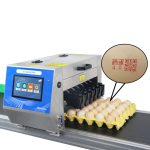 Six Head Egg Inkjet PrinterS10-6 |
High-volume grading lines on standard trays | ≈ 36,000 eggs/hour20 trays/min600 dpi HD | 12.7 mm max | USB / HDMI |
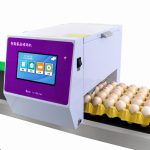 Six Nozzle Egg Coding MachineS600D |
Mixed tray layouts that must not be sorted | ≈ 36,000 eggs/hour20 trays/min300-600 dpi | 2-12.7 mm | USB, RS232 |
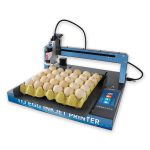 XY110 Egg Inkjet PrinterXY110 |
Smaller farms, duck eggs and mixed sizes | ≈ 9,800 eggs/hour30 eggs in ~11 s300-600 dpi | 2-12.7 mm | USB, DB9 |
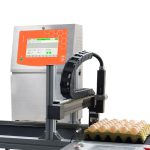 Small Character Egg PrinterS200PLUS |
20 mm characters, database codes | ≈ 7,200 eggs/hour15 s per traydpi on request | 2-20 mm | USB, RS232, Ethernet |
Hourly figures are calculated from the speed the factory publishes, on a standard 5 × 6 tray (30 eggs). Real throughput follows your line speed, loading and stoppages.
Tell us how many eggs you pack a day and we will tell you whether a tray machine is enough.
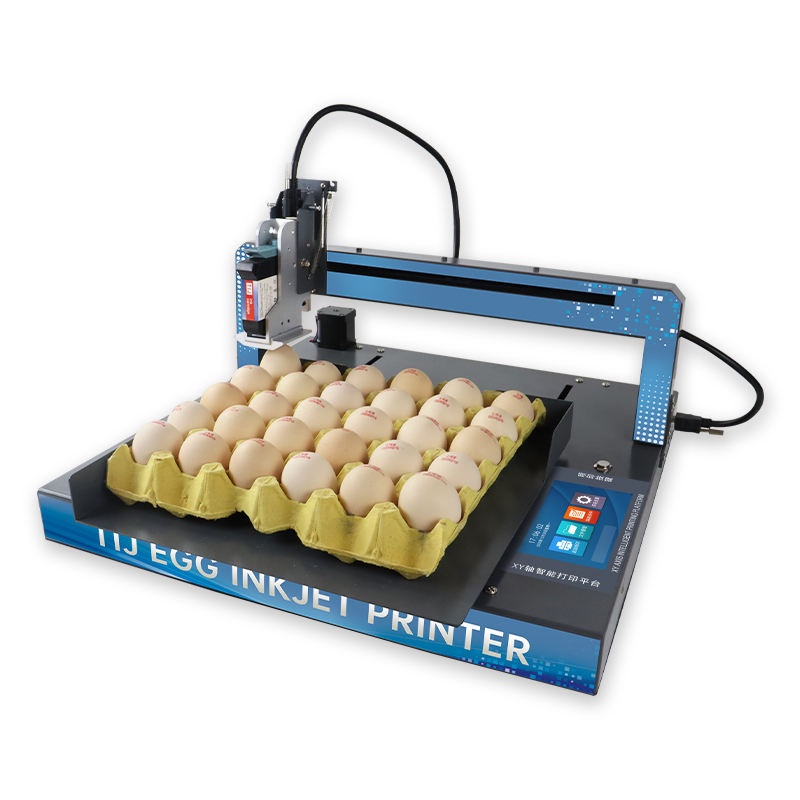
XY110
Tray-type XY gantry, one full tray in about 11 seconds
SHICAI builds food-grade egg coding machines for poultry farms and packers in the US, UK, EU, Australia and worldwide. Tell us your daily volume and egg types, and our engineers will recommend the right model and send a free sample print.
Tell us about your line — we reply within 24h.