Custom egg marking is the cheapest branding a poultry farm can buy, because the carton gets thrown away and the shell does not. A logo, a farm name or a single letter on every egg travels further than any label. What decides whether it reads as a brand or a smudge is size, position, contrast and how much detail survives.
A carton tells the buyer who packed the eggs. Custom egg marking tells them again after the carton is gone.
There is a commercial argument too. A shell mark lets a farm sell loose eggs into a shop that would otherwise only take branded cartons, because they arrive already identified.
It also closes a quiet problem. When eggs from two farms share a crate, a shell mark makes the difference visible without opening anything.
Artwork. The head prints a graphic: a farm logo, a wordmark or a simple shape. This needs a head that handles patterns rather than plain text, and enough character height to hold the detail.
A code that stands for the brand. A short letter code or a QR square does the same job with fewer dots. It survives a smaller print height and reads on a dark shell where a detailed logo would turn to mush.
The choice usually follows the shell. Brown shells forgive a heavier mark, white shells show fine detail better, and speckled shells need a shape that does not depend on thin lines.
Most marks fail on one of these four, and none of them is about the printer itself.
| Detail | The usual choice | What goes wrong |
|---|---|---|
| Size | As large as the height allows | It swallows the space the date needs, so one field gets dropped |
| Position | Near the blunt end, on the shoulder line | Placed on the rolling face, where eggs rub against each other |
| Contrast | Red or blue on brown shells | White or pale ink on a pale shell, invisible at arm’s length |
| Detail | A wordmark, or a shape with two or three strokes | Fine line art that fills in once the dots merge |
Position is the one people skip. Eggs roll against each other in the tray, so a mark on the shoulder rubs more than a mark near the blunt end.
A date code can be rough and still be read at a glance. A logo cannot, because the eye recognises a shape before it reads a character.
That puts two specifications ahead of the rest. Print height from 2 to 20 mm gives artwork room to breathe, and a working distance of 3 to 30 mm lets the head sit clear of the conveyor without a guide rail pressed against the shell.
Ink decides the rest. A mark that smears on a warm egg or lifts under condensation reads as a defect, not a brand, which is why food-grade ink with high adhesion matters more here than on a date code.
At a few thousand eggs a day one unit is enough. Past that, a second unit beats a bigger one.
Most farms end up printing both, and the order matters. The logo goes where the eye lands, the date and lot code go where an inspector looks.
That is why interface choice is not a technicality: the logotype can be a stored job while the variable data arrives from a file.
The configuration is described on the small character egg printer page, which covers the 20 mm height and database-driven codes.
The temptation is to design a full identity before printing a single egg. The farms that get it right do the opposite.
Print one mark on one flock for a month. Watch how it holds after packing, after a week in a cold room, and after a customer has handled it twice.
One thing worth knowing before the design work starts: US food labelling rules sit in 21 CFR Part 101 and govern the carton rather than the shell. The mark on the egg is a commercial choice, which is exactly why it works as a brand.
Custom egg marking is not a one-off design job. More brand-and-code combinations are collected under our coding solutions.
Same factory, four jobs. A mark that carries artwork needs character height, which is why the last row leads on detail.
| Machine | Best for | Speed and resolution | Height | Interface |
|---|---|---|---|---|
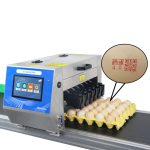 Six Head Egg Inkjet PrinterS10-6 |
High-volume grading lines on standard trays | ≈ 36,000 eggs/hour20 trays/min600 dpi HD | 12.7 mm max | USB / HDMI |
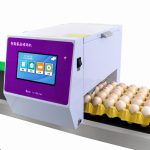 Six Nozzle Egg Coding MachineS600D |
Mixed tray layouts that must not be sorted | ≈ 36,000 eggs/hour20 trays/min300-600 dpi | 2-12.7 mm | USB, RS232 |
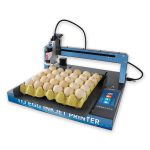 XY110 Egg Inkjet PrinterXY110 |
Smaller farms, duck eggs and mixed sizes | ≈ 9,800 eggs/hour30 eggs in ~11 s300-600 dpi | 2-12.7 mm | USB, DB9 |
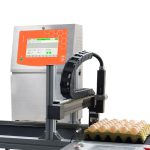 Small Character Egg PrinterS200PLUS |
20 mm characters, database codes | ≈ 7,200 eggs/hour15 s per traydpi on request | 2-20 mm | USB, RS232, Ethernet |
Hourly figures are calculated from the speed the factory publishes, on a standard 5 × 6 tray (30 eggs). Real throughput follows your line speed, loading and stoppages.
Send us your logo and daily volume and we will tell you the smallest print height at which your logo still reads.
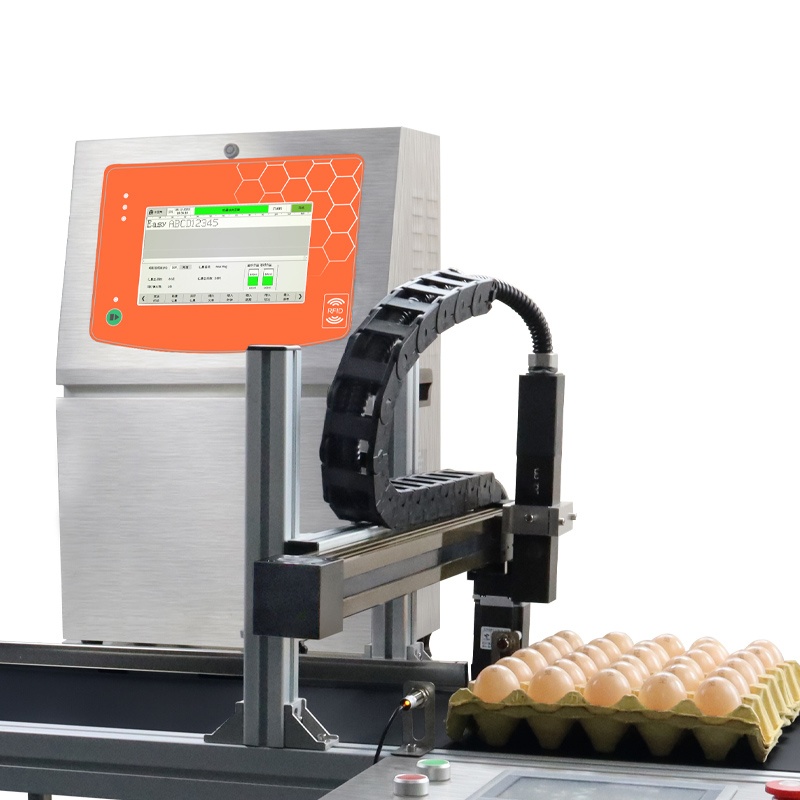
S200PLUS
20 mm characters and database-driven codes on eggs
SHICAI builds food-grade egg coding machines for poultry farms and packers in the US, UK, EU, Australia and worldwide. Tell us your daily volume and egg types, and our engineers will recommend the right model and send a free sample print.
Tell us about your line — we reply within 24h.