An egg printer only earns its keep when it keeps up with the grader behind it. On most packing lines, the bottleneck is not the marking head. It is tray pitch, the wash-down routine, and the wrong ink for a cold room. These six checks decide whether a unit fits your hall before you transfer a deposit.
A grader at full tilt will not wait for a printer. If marking sits inside the line, the unit has to fire on every tray that arrives, cracked shell or missing egg included. Controllers that expect a perfect tray pattern drop codes, and somebody re-runs those trays by hand at the end of the shift.
Placement matters more than sharpness. Buyers reject a tray when the code lands on the shoulder instead of the crown, or when ink bleeds into the air cell. A head that fires 2 to 5 mm from the shell keeps characters tight and never touches the egg.
Run these in order. Each one has ended a deal on a line we quoted.
Four units cover most of the requests we get. What separates them is print height, mounting, and whether the machine has to travel between houses.
| Model | Print height | Speed | Best fit |
|---|---|---|---|
| Six Head Egg Inkjet Printer (S10-6) | Up to 12.7 mm, 600 dpi | 20 trays per minute, about 600 eggs per minute | Standalone packing halls |
| Six Nozzle Egg Coding Machine (S600D) | Up to 12.7 mm | 20 trays per minute with no line slowdown | Existing grading conveyors |
| XY110 Egg Inkjet Printer (XY110) | 2 to 12.7 mm, 300 to 600 dpi | Matches line speed | Small farms, two or three houses, 12 kg portable |
| Small Character Egg Printer (S200PLUS) | 2 to 20 mm | Matches line speed | Cartons, QR and barcode work, 3 to 30 mm distance |
If your trays hold 30 eggs and the grader never stops, the first two rows are your shortlist. The XY110 earns its place when one machine has to serve two houses, because it weighs 12 kg and rides a trolley between them.
Packers who also code cartons usually add the Small Character unit. It prints dynamic barcodes and QR codes, pulls codes from an external database or a serial feed, and ships with 14 interface languages, so the line does not need a second operator who speaks a different system.
Head count is the largest line item, then the controller and the enclosure. A six-head array costs more up front than a single-head unit, but the per-egg cost inverts once you code whole trays every day.
Two other items move the quote: print height and interface work. A 2 to 20 mm range with database connectivity asks more of the controller than a fixed date stamp. Food-grade inks are formulated for contact with a food surface, and the wider factory standard most buyers quote is ISO 22000, which covers the whole chain rather than the ink alone.
Give the supplier your tray size, egg types and code content, and you get a budget band you can compare. Ask for a number without those three facts and you will collect quotes that are not measuring the same machine.
Send three things and the answer comes back straight: trays per minute at your peak, egg types (hen, duck, quail), and the exact code you need on the shell. An engineer confirms head count, ink and mounting, then quotes against your line instead of a catalogue page.
Still comparing methods? The solutions library sets stamps, labels and inkjet against each other with real numbers. If the shortlist is already down to two machines, ask an engineer for a fit check, or browse the full range first.
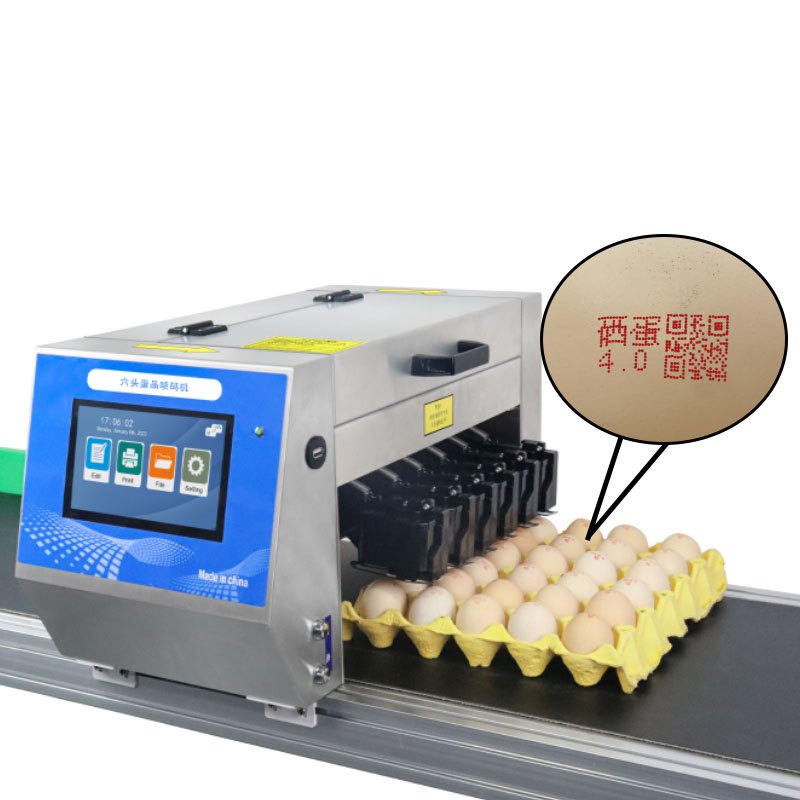
S10-6
Six print heads, one full 5×6 tray per pass
SHICAI builds food-grade egg coding machines for poultry farms and packers in the US, UK, EU, Australia and worldwide. Tell us your daily volume and egg types, and our engineers will recommend the right model and send a free sample print.
Tell us about your line — we reply within 24h.